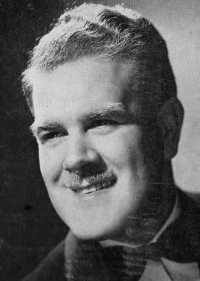
 Phil
Tate was born in Bramley,
Yorkshire, on 28th April
1922 and was educated at
West Leeds High School.
He developed an early
interest in music, taking
up the violin at the age
of eight. Phil
Tate was born in Bramley,
Yorkshire, on 28th April
1922 and was educated at
West Leeds High School.
He developed an early
interest in music, taking
up the violin at the age
of eight.
He
concentrated on classical
music until the outbreak
of war, when he joined
the Royal Air Force as a
radar mechanic. In 1943
he was transferred to
welfare and was then able
to form his own orchestra
of service musicians
called the Silver Wings
Dance Orchestra. After
demobilisation he formed
a civilian orchestra
which included most of
his wartime players.
In
1948 he accepted an
appointment as Musical
Director to the
Folkestone Corporation
and broadcast both from
Folkestone and London.
Regular broadcasting
commenced in 1950, when
he gave the first of his
144 'Music
While You Work'
programmes. This was with
a small band which he was
then directing at the
Hammersmith Palais
(opposite Lou
Preager)
— a residency held
by both bandleaders for
many years.
Phil
Tate subsequently decided
to form a larger
orchestra for
broadcasting and, knowing
that the BBC specifically
encouraged bands to sound
'different', he set about
creating his own
particular 'sound' —
a blend of three flutes,
five saxophones and
clarinet with two pianos,
trumpet and rhythm. This
produced a warm, friendly
sound with the same
spine-tingling effect as
the famous Glenn Miller
sound yet in no way was
this an imitation of this
or any other style.
Phil
Tate's orchestra was a
firm favourite on radio
during the fifties and
sixties. He even
compéred his own
breakfast-time series
featuring his orchestra
and quintet, which he led
on clarinet. By this
time, television
audiences had come to
know him as the resident
musical director for the
various beauty contests
sponsored by Mecca and
leading up to the Miss
World Contest in the
Royal Albert Hall each
November. Phil also
appeared on the
children's television
programme 'Crackerjack!'
- as a conjuror!
For
their broadcasts, the
band specialised in
strict-tempo dance music
and its success led to a
contract with Oriole
Records and the issue of
many 78s and 45 rpm
records as well as some
long-playing records.
Phil Tate and his
Orchestra had already
been captured on
celluloid in the early
fifties when they
appeared in the film
'Green Grow the Rushes'.
It is for radio, however,
that Phil Tate is best
remembered, and for the
16 years he played
regularly in 'Music While
You Work'. As his
programmes were largely
in medley form, he often
got through about 40
pieces in a 45-minute
programme!
By
the sixties, Phil Tate
had moved from the
Hammersmith Palais to the
Ilford Palais and, around
1964, he made some minor
changes to the
instrumentation of the
orchestra and to the
style of the programmes
by introducing some
longer arrangements. He
replaced the second piano
with a guitar (presumably
to facilitate the playing
of some current 'pops').
The blend of flutes and
saxes was retained.
When
the Ilford Palais
residency ended, Phil
Tate moved to the Locarno
in Streatham where he
stayed until 1968, at
which time he handed the
band over to singer Ken
Barrie, relinquishing
full-time bandleading as
he had become part of the
Mecca management.
However, regular
broadcasting continued in
Breakfast Special with a
slightly smaller
combination known as Phil
Tate’s Windjammers,
which had a distinctive
but quite different
style. This was an eleven
piece band consisting of
three trumpets, four
saxes, piano/organ,
guitar, bass and drums.
The trumpets were always
muted with bucket mutes -
hence the title
'Windjammers' and played
in unison with the saxes,
in a swinging style - not
unlike Count Basie.
In
1982, when the BBC
brought back MWYW for one
week, Phil Tate was asked
to reconstitute his
orchestra in the style
for which it was best
remembered. This he did,
restoring the second
piano and using only
arrangements from the
original series. The
success of this week (and
in particular, Phil
Tate’s broadcast)
led to a resumption of
the programme in 1983,
and Phil again took part.
The BBC assumed that he
would want to use the
Windjammers, but Phil
insisted on using the
full orchestra as before.
So, despite what was
shown in the Radio Times,
and even incorrectly
announced on air, what
was broadcast was Phil
Tate and his Orchestra!
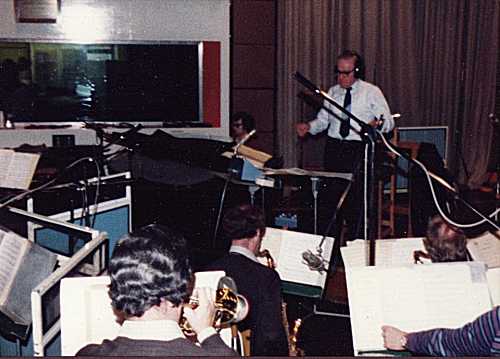
Phil Tate
rehearsing the orchestra
for a live broadcast on
8th October 1982
By
this time, Phil had been
out of regular
music-making for some
while, although he was
still conducting for the
annual Miss World Contest
plus the associated Miss
Scotland, Miss Wales and
Miss England contests for
which he conducted for 27
years! His main
occupation now was as
Managing Director of
Mecca Agencies, a joint
position with Ivor Rabin
(Oscar Rabin' s son).
In
1990, the BBC celebrated
the 50th Anniversary of
'Music While You Work'
with a further week of
programmes and, once
again, Phil Tate took
part. It was 40 years
since his first
appearance on the show
and this broadcast was
destined to be his
swan-song at least as far
as radio was concerned.
Happily his broadcasting
repertoire is now in the
safe hands of his pianist
of 26 years, Bruce Graham
(to whom I'm grateful for
some of the information
in this article). Having
retired from Mecca
Agencies in 1987, Phil
Tate continued with
occasional band work
until 1992. For the next
eight years he acted as
director of the Music
Users' Council.
Sadly,
the last five years of
Phil Tate's life were
marred by debilitating
illness, and he died on
December 9th. 2005. His
wife had predeceased him
and he is survived by two
sons.
Listen
to Music While You Work
played by Phil Tate and
his Orchestra
as broadcast on BBC Light
Programme at 3.31pm on
13th January 1983
Listen
to Music While You Work
played by Phil Tate and
his Orchestra
as broadcast on BBC Light
Programme at 3.31pm on
31st August 1964
MUSIC
WHILE YOU WORK
played by Phil Tate and
his Orchestra
on 31st August 1964
Calling
All Workers (Sig)
I won’t dance
I love you because
I love you for
sentimental reasons
Slightly Latin
Hard Day’s night
Nicola
Follow me
Getting sentimental over
you
Rise and fall of Flingel
Bunt
You
Mandy
Here Comes Summer
Girl from Ipanema
She Loves me
Let’s get away from
it all
Old Piano Roll Blues
Relax-ay-vous
Answer Me
Spanish Harlem
Don’t throw your
love away
Come Fly with me
Jacaranda
Put on a happy face
Zing went the strings of
my heart
Ma, he’s making eyes
at me
Calling All Workers (Sig) |
Eric
Coates
Irving Berlin
Leon Payne
William Best
Johnny Douglas
Lennon/McCartney
Steve Race
Frederick Loewe
George Bassman
Hank Marvin
Evans
Elliott
Kerry Keller
Antonio Carlos Jobim
Gerry Bock
Matt Dennis
Cy Coben
Sammy Cahn
Winkler
Phil Spector
Billy Jackson
Jimmy van Heuson
Phil Tate
Charles Strouse
James Hanley
Con Conrad
Eric Coates |
Listen
to Music While You Work
played by Phil Tate and
his Orchestra
as broadcast on BBC Radio
2 at 3.30pm on 25th June
1990
Listen
to Music While You Work
played by Phil Tate and
his Music
as broadcast on BBC Radio
2 at 12.00pm on 5th
October 1983
MUSIC
WHILE YOU WORK
played by Phil Tate and
his Music
on 5th October 1983
Calling
All Workers (Sig)
Great Day
Heart
I'll get by
Sitting on top of the
world
Blue Skies
Rainbow round my shoulder
World is waiting for the
sunrise
Hold my hand
Magic Moments
Kiss me Honey
A Fine Romance
Eternally
Love Letters
A Certain Smile
Jeepers Creepers
Gal in Calico
Rose of Wahington Square
Luxembourg Polka
Gigi
When my dreamboat comes
home
Calling All Workers (Sig) |
Eric
Coates
Vincent Youmans
Adler
Ahlert
Young
Irving Berlin
Al Jolson
Seity
Lawrence
Burt Bacharach
Timothy
Jerome Kern
Charles Chaplin
Young
Payne
Harry Warren
Schwarz
MacDonald
Reissdorf
F. Loewe
Franklin
Eric Coates |
Listen
to Music While You Work
played by Phil Tate and
his Orchestra
as broadcast on the BBC
Light Programme at
10.31am on 11th March
1965
MUSIC
WHILE YOU WORK at 10.31am
on 11th March 1965
played by Phil Tate and
his Orchestra
Calling
All Workers (Sig)
Too Close for Comfort
People
Garden in the Rain
Genie with the Light
Brown Lamp
On the Street Where you
Live
Maggie Maggie May
Walk Away
Folks get married n the
Spring
I'll never find another
You
Dear Heart
Mexican Shuffle
I'll Walk Alone
A Spoonful of Sugar
Jacaranda
Put on a Happy Face
Calling All Workers (Sig) |
Eric
Coates
Jerry Bock
Jule Styne
Carroll Gibbons
Hank Marvin
Frederick Loewe
Lionel Bart
Jurgens
Walsh
Springfield
Henry Mancini
Herb Alpert
Jule Styne
Sherman
Phil Tate
Strouse
Eric Coates |
Listen
to Music While You Work
as broadcast at 3.30pm on
8th October 1982
played by Phil Tate and
his Orchestra
MUSIC
WHILE YOU WORK
played by Phil Tate and
his Orchestra
on 8th October 1982
Calling
All Workers (Sig)
Poppa Piccolino
There, I've said it again
Broadway Melody
Jubilee hayride
Serenata
From Russia with love
Cherry Pink
Alabama Jubilee
Everybody loves somebody
A fine romance
People
Among my souvenirs
Sing a song of sunbeams
A pocketful of dreams
Meet the sun halfway
Kiss me honey
Under the bridges of
Paris
Swinging Safari
I'm in a dancing mood
Dancing with my shadow
My hat's on the side of
my head
Eternally
When my dream boat comes
home
Calling All Workers (Sig) |
Eric
Coates
Mascheroni
Evans, Mann
Nacio Herb Brown
Syd Dale
Leroy Anderson
John Barry
Louiguy
Cobb
Lane
Jerome Kern
Jule Styne
Horatio Nicholls
Monaco
Monaco
Monaco
Timothy
Vincent Scotto
Bert Kaemfert
Sigler
Harry Woods
Harry Woods
Charles Chaplin
Dave Franklin
Eric Coates |
Listen
to a broadcast of Music
While You Work by Phil
Tate and his Orchestra
*** As the precise date
of this broadcast is
unknown, I am unable to
provide a listing at this
time,
however the undernoted
listing will give an idea
of the type of programme
provided by Phil Tate in
the early Sixties ***
MUSIC
WHILE YOU WORK at 3.45
p.m. on 2nd January 1961
Played by Phil Tate and
his Orchestra
Calling
All Workers (Sig)
I'm in a Dancing Mood
Dancing With My Shadow
My Hat's on the Side of
My Head
My Little Corner of the
World
Whispering Tango
You Turned the Tables on
Me
El Pandero
Red Sails in the Sunset
Dreamin'
Everything’s in
Rhythm With My Heart
One, Two, Button My Shoe
Just in Time
Snowcoach
Paradise
Isn't This a Lovely Day
Easter Parade
Madeleine
Cindy Lou
Love Walked In
The Love Nest
I've Got My Eyes
Romantica
Rustlin'
Cuban Fiesta
To Each His Own
High Tide, Low Tide
Rosalie
You're the Cream in My
Coffee
There's a Small Hotel
Don't Blame Me
Try a Little Tenderness
Somebody Loves Me
Once in a While
Kickin' Up the Leaves
Mountain Greenery
Ain't She Sweet
You Forgot to Remember
Rosemarie
Bye, Bye, Baby
Calling All Workers (Sig) |
Coates
Sigler
Woods
Woods
Pockriss
Munro
Alter
Baker
Kennedy
De Vorzon
Sigler
Burke
Styne
Stanford
Brown
Berlin
Berlin
Addison
Shepherd
Gershwin
Hersch
Porter
Rascel
Russell
Ellis
Livingstone
Race
Porter
De Sylva
Rodgers
McHugh
Woods
Gershwin
Edwards
Bart
Rodgers
Green
Berlin
Friml
Robin
Coates |
|