It
was in the dark days of
1940 that the BBC
instituted 'Music While
You Work', following a
Government suggestion
that morale in industry
would be improved if
there were daily
broadcasts of cheerful
music piped into the
factories. The theory
(which turned out to be
right) was that improved
morale would lead to
better production. The
concept was for two half
hour programmes each day,
one at 10.30am and the
other in mid-afternoon. A
different band, orchestra
or ensemble would play
each day and it was felt
that the best programmes
were those which made
workers feel inclined to
whistle or sing along
with the music. Because
the music would have to
compete with factory
noises, and be heard
through tannoys, the BBC
insisted on a fairly
constant sound level,
plenty of familiar tunes,
nothing too slow and
nothing very fast. (
Curiously, it was
believed that very fast
music would have an
unsettling effect on
workers). In fact, the
BBC issued memos which
set out the quite
stringent rules that were
to be applied to the
programme - one of which
read:
1.
Banned completely - all
numbers with predominant
rhythm, insufficient
melody, or other
unsuitable
characteristics.
2. Banned Completely -
numbers that are
lethargic or unsuited to
any speeding up of tempo.
3 Banned completely - all
modern slow waltzes , due
to their soporific
tendencies. |
There
was also a long list of
pieces that were deemed
unsuitable for one reason
or another, such as 'Deep
in the Heart of Texas'
which has a clapping
motif, which it was felt
would encourage workers
to bang their spanners on
the machinery, possibly
doing damage!
The
first programme was on
Sunday 23rd. June 1940
and was played by Dudley
Beaven at the theatre
organ with the afternoon
edition provided by a
trio called The
Organolists, which in
later years evolved as Jimmy
Leach and his Organolians
who, in fact played the
final edition in
September 1967, some
16781 editions later!
Initially, the programme
had no signature tune,
but light music composer
Eric Coates had just
written a march called
'Calling All Workers' and
this was adopted as the
signature tune from
October 1940. Orchestra
leader Wynford
Reynolds
was appointed 'Music
While You Work Organiser'
in 1941 and one of his
tasks was to visit
factories around the
country, ascertaining
workers' opinions on the
programmes and, more
importantly, the
suitability of the
contributing musical
combinations. Pizzicato
violin playing was
outlawed (because it was
inaudible) as were 'over
fussy' arrangements that
were likely to obscure
the clear cut melody line
- an essential
requirement that also led
to the exclusion of jazz.
The
programme featured
ballroom dance
orchestras, light
orchestras, brass and military
bands,
small instrumental
ensembles and (initially)
cinema organs, but these
were eventually phased
out because it was felt
that their tone was
incompatible with factory
conditions. Although
nearly 500 musical
combinations were
featured over the years,
some 60 only appeared
once, because they were
found unsuitable,
sometimes for what one
might consider petty
reasons. For example,
bandleader Ken Mackintosh
was dropped after just
one show because his
drummer played too many
'rim shots' - which
apparently sounded like
gunfire over factory
tannoys! Incidentally,
the BBC considered it
part of their brief to
advise factory managers
as to the most suitable
sound reproduction
equipment.
During
the war, many factories
were in production
throughout the night
(particularly munitions),
so a third edition of
'Music While You Work'
was introduced in 1942,
at 10.30 pm. for the
night shift. This lasted
for the duration of the
war, but was reintroduced
between 1947 and 1950 -
but in an early evening
slot. BBC executives were
quite sure that MWYW had
helped to win the war -
there was apparently a
13% increase in
production during the
times of transmission !
Although
primarily intended as a
morale booster for
industry, MWYW proved
very popular with
domestic listeners,
regularly achieving an
audience of four million.
To this must be added its
'captive audience' in the
factories and, by the
fifties, the burgeoning
number of motorists who
found it an ideal
accompaniment. It was
certainly very different
to the 'boom-thud'
cachophany emitted from
many cars today !
Over
the years some once very
famous names appeared on
the programme: Mantovani,
Victor Silvester, Frank
Chacksfield, Harry
Leader,
Lew Stone, Joe Loss - to
name a few. The most
popular combinations got
the most broadcasts with Troise
and his Banjoliers
(in later years directed
by Jack Mandel) doing an
amazing 476 shows, with Cecil
Norman and the Rhythm
Players
coming a close second
with 466 editions. For
most of its run, MWYW
featured a weekly
(sometimes twice-weekly)
slot for brass and
military bands -
including all the Guards
bands,
the Royal Artillery, the
Royal Engineers
and the R.A.F. Central
Band amongst others.
Famous names from the
brass band world - Black
Dyke, Grimethorpe
Colliery were just two of
the many top bands
included. From the light
orchestral world, popular
contributors were Ronnie
Munro,
Bernard
Monshin,
Harold
Collins
and Anton
and his Orchestra.
From the dance band
world, Phil
Tate,
Tommy
Kinsman,
Jack
White,
Syd
Dean
and Bill
Savill
will be remembered by
many people.
The
popularity of 'Music
While You Work' in the
post-war years led to the
afternoon editions being
extended to forty-five
minutes. Many of the
dance bands found this
quite arduous, as brass
players often found it
difficult to maintain
their 'embouchure' for
long periods, their lips
becoming quite tired
towards the end of the
programme. It has to be
remembered that it was a
requirement of the
programme that the music
should be continuous, so
if a band wanted to have
more than about three
seconds between numbers,
a piano or celeste link
had to be inserted. Quite
a number of combinations
adopted this in later
years - as it not only
gave them more time to
change their music, but
had the additional
advantage of effecting a
modulation between
numbers. If there was no
link, the conductor had
to ensure, when planning
his programme, then the
key of each piece was
compatible with the key
of the closing notes of
the preceding piece. A
delightful characteristic
of the programme was that
you could often hear the
frantic rustling of
manuscript paper between
numbers!
'Music
While You Work' was
broadcast live until the
Summer of 1963, after
which time, most
programmes were
pre-recorded - usually
the previous day and
often in the evenings.
This enabled more studios
to be free for other
programmes during the
daytime. When the
Saturday morning show was
discontinued in 1964, it
proved to be the 'thin
edge of the wedge', as in
1966, the afternoon
editions ended. The final
edition of MWYW was
broadcast on 29th.
September 1967 - the last
day of the Light
Programme.
It
was revived for a week in
October 1982, as part of
the BBC's Diamond Jubilee
Celebrations. It proved
to be so successful that
the programme was
reinstated on a daily
basis on 4th January 1983
- running for over a
year! Further short
revivals took place in
1990 and 1991 with a
final 'one-off' programme
in 1995, played by the
Victor Silvester
Orchestra.
As
a footnote, it should be
mentioned that Radio
Three broadcast a live
edition of 'Music While
You Work' on 24th June
2011 as part of their
otherwise excellent light
music festival entitled
'Light Fantastic'.
Apparently confusing it
with 'Workers'Playtime'
they staged it in a
factory near Manchester
in front of an audience
of workers, who had been
given time off to hear
it. The 90-piece BBC
Philharmonic Orchestra,
conducted by Stephen Bell
even donned
high-visibility jackets
for the occasion.
Unfortunately, those
responsible had obviously
never heard the programme
which, instead of being
non-stop light music as
was traditional, was
interrupted by applause
and announcements. It
also included several
items that would never
have been considered
suitable for the series.
It is sad that there is
probably nobody left at
the BBC who remembers the
show and even sadder that
they seemingly lacked the
initiative to listen to
the preserved editions in
their own Sound Archives
- or indeed, the many
examples on this site!
Here
is a selection of bands
and orchestras who played
on the programme.
Click
on the links to hear the
full programmes
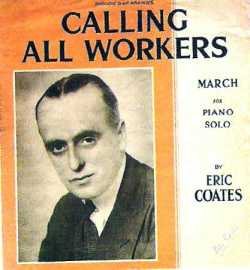
The stirring theme tune
was called Calling
All Workers
by Eric Coates and is
available on
Guild Music CD GLCD5128.
A
Medley of intro's
An
Interview with Brian
Reynolds for the BBC by
Russell Davies
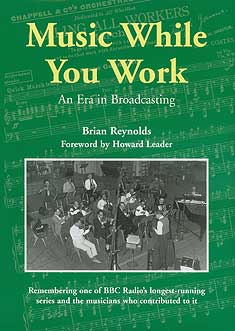
Click
on the book cover for
further details, reviews
and ordering information
Many
editions of Music While
You Work and countless
other programmes are
available for hire to
members of O.R.C.A (Old
time Radio-programmme
Collectors' Association).
Membership details from
O.R.C.A. P.O.
Box 1922, Dronfield,
Sheffield S18
8XA or by e-mailing
graemeotr@yahoo.co.uk.
|