
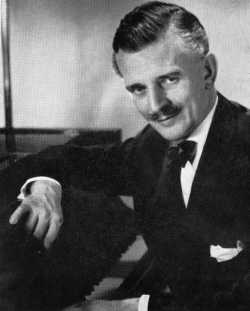
 It
is unusual to associate
the role of a dance band
leader with that of a
distinguished career in
the Army. Such was the
case, however, with Ian
Stewart, whose
strict-tempo pianistic
style was a feature of
radio for many years. It
is unusual to associate
the role of a dance band
leader with that of a
distinguished career in
the Army. Such was the
case, however, with Ian
Stewart, whose
strict-tempo pianistic
style was a feature of
radio for many years.
Ian
Edward Stewart was born
in December 1908 of a
Scottish father and an
American mother, spending
most of his early life in
Seaton, Devonshire. He
was a chorister at
Salisbury Cathedral and
spent three years at St
Edwards, Oxford. A pupil
of Herbert Howells, Ian
Stewart became organist
at Chalfont, Somerset, at
the age of 18. In
complete contrast, he had
also formed his own band
in Seaton, which he
called the Geisha Dance
Band. He began his
professional career in a
rather humble way playing
the piano for a
marionette show on the
beach at Margate. This
led to an engagement
touring with the musical
'So this is Love' —
initially as pianist but
later as Musical
Director. Next, Ian
Stewart turned his hand
to music publishing, a
venture which occupied
him for five years prior
to his going to the USA
where he frequently
broadcast for NBC.
Returning
to London in 1935, Ian
Stewart was reintroduced
to dance music by his
idol, Carroll Gibbons,
joining the Savoy Hotel
Orpheans as Deputy Leader
and second pianist in the
years leading up to the
Second World War.
His
military career commenced
as a territorial with the
London Scottish and ended
as a Brigade Major with
the 17th Indian Division;
he received a meritorious
award of MBE in Burma in
1945. When demobilised in
1946, he immediately
formed his own band at
the Berkeley Hotel,
London. Although he had
done some pre-war work in
radio, Ian Stewart, his
piano and his orchestra
began regular
broadcasting in 1947.
Ian’s
admiration for Carroll
Gibbons was such that,
initially, he
deliberately emulated his
style but soon realised
that he would be more
successful if he had his
own way of playing. He
therefore evolved a quite
distinctive staccato
style, making use of
repeated notes to great
effect, which immediately
identified him. With the
premature death of
Carroll Gibbons in 1954,
Ian Stewart took over the
band, reviving the name
of Savoy Hotel Orpheans.
For radio purposes, he
used a combination of
piano, bass, guitar,
drums, saxophone
(doubling clarinet) and
accordion; the group was
called Ian Stewart and
his Quintet (later
Quartet, when the guitar
was omitted from the
group in the early
sixties.)
The
band broadcast regularly
in 'Bright
and Early',
'Morning
Music'
and 'Music
While You Work',
playing 264 editions over
20 years. As a solo
pianist he was a frequent
contributor to the
15-minute series 'Piano
Playtime'. Having a
cultured voice, he was
one of the few pianists
who was allowed to
introduce his own
programmes. His signature
tune for these programmes
was his own composition,
'Story of a Song'.
As
well as broadcasting, Ian
Stewart made many records
for Decca, Parlophone and
Fontana, including a
series called Hits For
Six — each featuring
six hits of the day. He
would have been hard put
to find six playable
tunes in the charts of
today!
Like
Carroll Gibbons before
him, Ian Stewart's name
became synonymous with
the Savoy Hotel, where he
played until his
retirement in 1978, the
occasion being celebrated
with a live television
performance in an early
evening magazine
programme.
An
elegant and articulate
man, Ian Stewart had all
the attributes of the
soldier that he once was.
Indeed, at the BBC he was
known as 'The Colonel'.
Some diners at the Savoy,
however, found him a
little aloof. Whereas
some bandleaders would
push their own
personality, Ian was very
reserved. 'I’m just
not an extrovert', he
said. 'I was never a
table-hopper —
perhaps I should have
been, I might have done
better and been more
famous!'
Although
he played requests, he
did not always play them
immediately. He once
recounted the story of a
drunken diner who
repeatedly asked for the
same tune. In
desperation, the irate
diner slapped a pound
note on the piano,
snarling 'I suppose you
are waiting for a tip'.
Stewart said 'I flicked
it off. It was very
satisfying seeing him
have to pick up his own
note!'
Ian
Stewart played for
Churchill, the Macmillans
at Number 10 and for the
Royal Family, the late
Queen Mother being a
devoted fan. When playing
for informal gatherings
he was warned not to make
the dances too long. The
procedure, however, was
to keep on playing whilst
a member of the Royal
Family was on the floor.
Ian Stewart recalled:
'The first time I went
there, I was about to
stop as the Queen left
the floor when somebody
whispered,
"There’s
somebody else coming
on." This went on
for ages. Eventually, a
perspiring Duke of
Edinburgh came over:
"Give it a break,
old man. I can be
lumbered much as anybody
else!"'
Ian
Stewart died on 30th July
1989, aged 80, following
a long illness.
Listen
to Music While You Work
played by Ian Stewart and
his Quartet
as broadcast on the BBC
Light Programme at 10.31
a.m. on 20th May 1965
MUSIC
WHILE YOU WORK
Played by Ian Stewart and
his Quartet
on 20th May 1965
Calling
All Workers (Sig)
It’s a hap hap happy
day
Red Roses for a blue lady
Eight by ten
Pickin’ a chicken
Marie
After you, Who?
If I ruled the world
Tango 65
Spoonful of sugar
Swinging on a star
King of the road
It’s not unusual
Smile
The Dummy song
Sweet Jennie Lee
Happy Wanderer
San Francisco
Who’s Sorry Now
Don’t Dilly Dally
Calling All Workers (Sig) |
Eric
Coates
Sammy Timberg
Roy Brodsky
Bill Anderson
Paddy Roberts
Irving Berlin
Cole Porter
Cyril Ornadel
Ponticelli
Alan Sherman
Jimmy van Heusen
Roger Miller
Les Reed
Charles Chaplin
Lew Brown
Walter Donaldson
Friedrich Moeller
Bronislaw Kaper
Ted Snyder
Fred Leigh
Eric Coates |
Listen
to Music While You Work
played by Ian Stewart and
his Quartet
as broadcast on the BBC
Light Programme at 10.31
a.m. on 27th March 1964
MUSIC
WHILE YOU WORK
Played by Ian Stewart and
his Quartet
on 27th March 1964
Calling
All Workers (Sig)
Happy Days and Lonely
Nights
Fings ain't wot they used
to be
Who wants to be a
millionaire
Mountain Greenery
Don't Blame me
My Special Dream
You were made for me
The Sweetest Sounds
Under the Bridges of
Paris
I left my heart in San
Francisco
How about you?
Could be the start of
something big
Dance On
The Yellow Rose of Texas
Have you ever been
lonely?
I like it
Twenty four hours from
Tulsa
Easter parade
Dear hearts and gentle
people
Something's gotta give
You've done something
with my heart
Margie
Calling All Workers (Sig) |
Eric
Coates
Fisher
Lionel Bart
Cole Porter
Richard Rodgers
Jimmy McHugh
Kaplan
Murray
Richard Rodgers
Vincent Scotto
Cory
Sammy Fain
Allen
Adams
George
De Rose
Murray
Burt Bacharach
Irving Berlin
Sammy Fain
Mercer
Noel Gay
Conrad
Eric Coates |
Listen
to Music While You Work
played by Ian Stewart and
his Quartet
as broadcast on the BBC
Light Programme at 10.31
a.m. on 1st October 1965
MUSIC
WHILE YOU WORK
Played by Ian Stewart and
his Quartet
on 1st October 1965
Calling
All Workers (Sig)
S'posin'
Ida Sweet as Apple Cider
When You've Got a Little
Springtime
When Somebody Thinks
You're Wonderful
Tears
Elizabeth
A Lot of Living To Do
I Left My Heart in San
Francisco
Sugartime
Am I Wasting My Time
Thank Heaven For Little
Girls
Who Can I Turn To?
Toot Toot Tootsie
Almost There
Whistle and Flute
Second Hand Rose
The Way You Look Tonight
Volare
Ain't She Sweet
I Whistle a Happy Tune
We'll All Go Riding on a
Rainbow
Calling All Workers (Sig) |
Eric
Coates
Denniker
Leonard
Woods
Woods
Uhr
Katscher
Strouse
Cory
Echols
Bibo
Loewe
Bricusse
Kahn
Keller
Woods
Hanley
Kern
Modugno
Ager
Rodgers
Woods
Eric Coates |
Listen
to 'Melodies to Remember'
played by The Ian Stewart
Quintet and Victor
Silvester and his
Ballroom Orchestra
as broadcast on the BBC
Light Programme at 1.30pm
on 25th. December 1963.
|