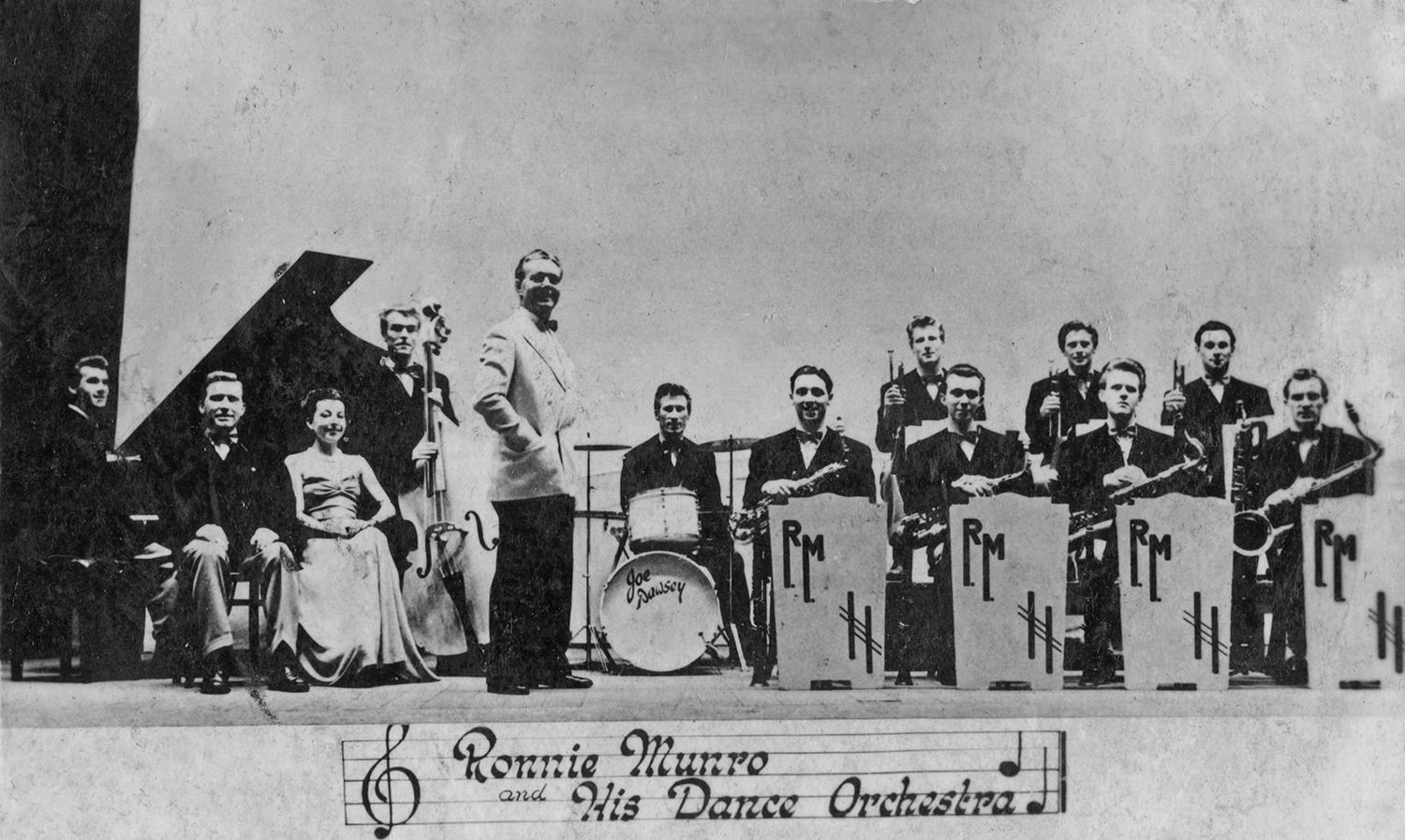
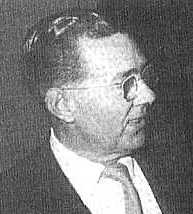
 Ronald
George Munro was born in
London in 1897. He
started to play the piano
at the age of eight.
Initially, he took
lessons from his mother
but was later taught by
Charles Woodhouse. At 17
he went to study at the
Guildhall School of
Music, under Joseph
Speight. From 1915 to
1918 he served in the
Army, but upon
demobilisation decided on
a career in music. He
started as pianist in
Moody's Club in Soho,
also playing in other
West End clubs, as well
as the Bow Palace and
Lyons' Corner Houses. In
1923, he joined the Emlyn
Thomas London Band, which
played in cinemas and
theatres, followed in
1926 with a spell at
Jade's Club In Golden
Square (formerly the
Little Club). Around this
time, Ronnie Munro was
becoming increasingly
busy as an arranger and
won arranging contests
sponsored by the Daily
Sketch and Melody Maker.
An arrangement of
'Carolina' resulted in an
engagement with Debroy
Somers and the
commencement of his
recording career. In 1926
he had a recording
contract for his own band
with Parlophone, becoming
the label's Director of
Dance Music, a job he did
for some years. This was
the beginning of a
13-year relationship with
EMI. Ronnie also recorded
for HMV, Regal Zonophone
and Columbia. He used a
variety of pseudonyms on
record, including: The
Roof Garden Orchestra,
The Merton Orchestra,
Parlophone Syncopaters,
West End Players and many
others. The hand-picked
personnel for these
recordings included Max
Goldberg, Carroll
Gibbons, Ted Heath,
Freddie Gardner, George
Evans and Jack Simpson. Ronald
George Munro was born in
London in 1897. He
started to play the piano
at the age of eight.
Initially, he took
lessons from his mother
but was later taught by
Charles Woodhouse. At 17
he went to study at the
Guildhall School of
Music, under Joseph
Speight. From 1915 to
1918 he served in the
Army, but upon
demobilisation decided on
a career in music. He
started as pianist in
Moody's Club in Soho,
also playing in other
West End clubs, as well
as the Bow Palace and
Lyons' Corner Houses. In
1923, he joined the Emlyn
Thomas London Band, which
played in cinemas and
theatres, followed in
1926 with a spell at
Jade's Club In Golden
Square (formerly the
Little Club). Around this
time, Ronnie Munro was
becoming increasingly
busy as an arranger and
won arranging contests
sponsored by the Daily
Sketch and Melody Maker.
An arrangement of
'Carolina' resulted in an
engagement with Debroy
Somers and the
commencement of his
recording career. In 1926
he had a recording
contract for his own band
with Parlophone, becoming
the label's Director of
Dance Music, a job he did
for some years. This was
the beginning of a
13-year relationship with
EMI. Ronnie also recorded
for HMV, Regal Zonophone
and Columbia. He used a
variety of pseudonyms on
record, including: The
Roof Garden Orchestra,
The Merton Orchestra,
Parlophone Syncopaters,
West End Players and many
others. The hand-picked
personnel for these
recordings included Max
Goldberg, Carroll
Gibbons, Ted Heath,
Freddie Gardner, George
Evans and Jack Simpson.
Ronnie
Munro became Musical
Director of HMV's house
orchestra (The New
Mayfair Orchestra),
composing and arranging
extensively for Jack
Hylton, Lew Stone,
Percival Mackey, Henry
Hall and Ambrose, whose
signature tune 'When Day
Is Done' was orchestrated
by Munro in an elaborate
concert style. The
thirties was possibly the
busiest period of Ronnie
Munro's career as, in
addition to playing with
several bands, he
arranged music for films,
being Musical Director
for British National
Pictures throughout the
period.
Ronnie
Munro's big break, as far
as broadcasting was
concerned, came late in
1940 when he was
appointed conductor of
the newly formed Scottish
Variety Orchestra
(the prefix BBC wasn't
used until after the
war). He was soon
broadcasting several
times a week and making
records with the
orchestra. One of his
most popular shows was
'Sunday Serenade', which
ran for several years.
Ronnie stayed with the
Scottish Variety
Orchestra until 1944,
when he handed the baton
over to Kemlo Stephen,
although he continued to
play in 'Sunday Serenade'
with his own orchestra,
usually broadcasting from
wherever the orchestra
happened to be located at
the time.
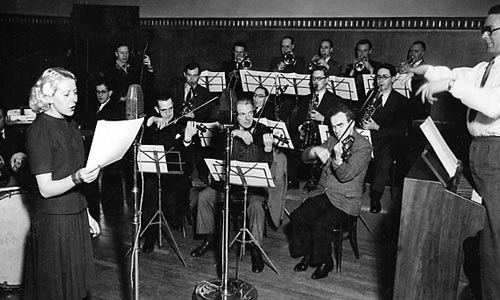
March 1942.
The BBC Scottish Variety
Orchestra conducted by
Ronnie Munro, with Ann
Rich at the microphone.
It
is evident from
information available to
researchers at the BBC
Written Archives Centre
that Ronnie Munro's
departure from the
Scottish Variety
Orchestra was far from
smooth. He had arranged
hundreds of pieces for
the orchestra and had
come to regard them as
his own property.
Furthermore, he intended
to continue to use them
in 'Sunday Serenade' with
his own orchestra, so he
took them away with him.
Unfortunately, the BBC
was adamant that the
arrangements were not his
property and could only
be used with prior
permission. A BBC
representative therefore
went to his home and
reclaimed them! After
some negotiation, Ronnie
Munro was finally loaned
three weeks' supply of
scores, by which time he
was expected to have
written new arrangements
for the series! 'Sunday
Serenade' continued under
Ronnie’s direction
until 1946. On one
occasion his car was
broken into outside his
home and all his
arrangements for the
following day's broadcast
were stolen. Undeterred,
Ronnie sat up all night
rewriting them so that
the broadcast could go
ahead. (Anybody who has
ever written out an
orchestration, complete
with band parts, will
realise that this was an
enormous and seemingly
impossible task.)
After
Ronnie Munro's 'Sunday
Serenade' ended
(reverting to the BBC
Scottish Variety
Orchestra), he got a few
broadcast dates with his
dance band, but a row
blew up during a 'Music
While You Work' rehearsal
when a sound engineer
told the saxophone
section that they were
playing too loudly. The
musicians, including
Ronnie Munro, took
exception to this
interference, declaring
it to be 'nonsense and
out of order'. The
engineer then went into
the next studio to find a
colleague who would back
him up. In this hostile
atmosphere the ensuing
broadcast did not go
well. At one point the
pianist was playing one
tune with the saxes
playing another and they
virtually ground to a
halt in the signature
tune, apart from one
trumpet which managed to
keep going. Possibly as a
result of this incident,
Ronnie Munro's dance band
ceased to be offered
broadcasts and when he
enquired in 1950 as to
the reason, he was curtly
told that the Light
Programme was not in the
market for his kind of
show.
Although
'off the air', Ronnie
Munro’s band
continued to tour the
country, playing five
summer seasons at the
Butlin's Holiday Camp in
Ayr and, in 1949 and
1950, visiting Eire,
where his became the
first British band to
broadcast on Radio
Eireann. As far as I can
ascertain, he didn’t
resume broadcasting for
the BBC until the
mid-fifties.
At
this point, let us pause
to review Ronnie
Munro’s talents as a
composer. He wrote
several popular songs,
including 'All Over
Italy' and the curiously
titled 'Gertie the Girl
With the Gong'; however,
he is surely
best-remembered for his
light orchestral
compositions, such as
'Punch and Judy Polka',
'Miss Pony Tail',
'Estorella' (paso doble),
'The Musical Typist',
'Ski Waltz', 'Fly Away
Peter', 'Summer
Promenade' and
'Galapagos'.
On
the recording side,
Ronnie Munro made a
number of records on the
Decca 'Music While You
Work' label, with both
the Scottish Variety
Orchestra and what he
termed his 'waltz
orchestra'. Decca
subsequently reissued a
number of Strauss waltzes
from these 78s on one of
their first long-playing
records.
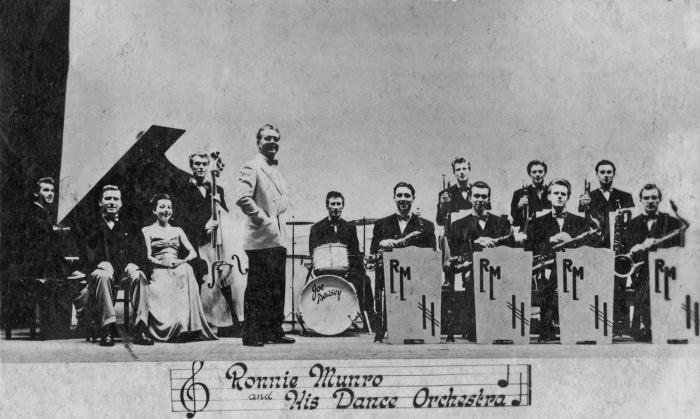
(click picture
to enlarge)
Picking
up his broadcasting
career, Ronnie Munro
formed a light orchestra
in 1956 which, initially,
consisted of strings,
woodwind, clavioline
(later organ), harp,
piano and rhythm. At this
time he was using
different-sized
combinations for
different programmes
including his eight-piece
salon ensemble, Harmony
Music, and orchestras of
12 or 17 players. He
later standardised to one
17-piece orchestra
specialising in tuneful,
rhythmic light music. The
orchestra consisted of
strings, organ, piano and
rhythm, the organ,
usually played by William
Davies. It had a most
attractive sound, the
combination of organ with
strings giving a warm,
friendly effect.
In
1962 Ronnie Munro formed
a 'more economical
group'; his idea being to
use variable percussion
effects produced by the
two percussionists and
the second guitar.
Electronic organ was
again present, with Munro
on piano. Never was the
phrase 'kitchen sink
department' more apt, as
the players appeared to
be rattling and banging
everything except each
other! He wanted to call
the group 'his Combo' but
the BBC insisted on the
more formal title of
Ronnie Munro and his
Sextet.
For
a time the sextet's
broadcasts alternated
with those of the
orchestra but Munro,
worried that the sextet
could actually threaten
the existence of the
orchestra, asked the BBC
if the group could be
used in 'Morning
Music',
keeping the orchestra for
'Music
While You Work'.
The BBC's response was to
axe the orchestra, the
small group obviously
being more economical
from their point of view.
Actually, by 1965 there
were eight players in the
group, although it was a
long time before the
billing changed from
'Sextet' to 'Music'. Over
the five years of the
group's existence, Ronnie
Munro made several
changes to both the style
and instrumentation. In
its final form, it
comprised two saxophones
(doubling flutes),
musette accordion (played
by Albert
Delroy),
piano, bass, percussion
and two guitars (one of
which was played
percussively). Ronnie
Munro's BBC career came
to an end in 1967 when
the group was given some
sessions in 'Breakfast
Special'.
Ronnie
Munro had been a stalwart
contributor to MWYW over
the years, appearing with
most of the combinations
which he had directed,
namely the Scottish
Variety Orchestra (91
performances), Dance Band
(10), Harmony Music (1),
Light Orchestra (52) and
Sextet (28).
When
it became apparent that
no further broadcasts
were going to be
forthcoming, Ronnie Munro
and his wife took the
decision to emigrate to
Johannesburg - a logical
step as he had, during
the sixties, played piano
and organ on cruises from
Southampton to South
Africa. Once there, he
re-formed his orchestra
for broadcasting, and
eventually became Head of
Light Music for SABC.
He
retired in 1975 and died
on 3rd July 1989, having
been blind for the last
seven years of his life.
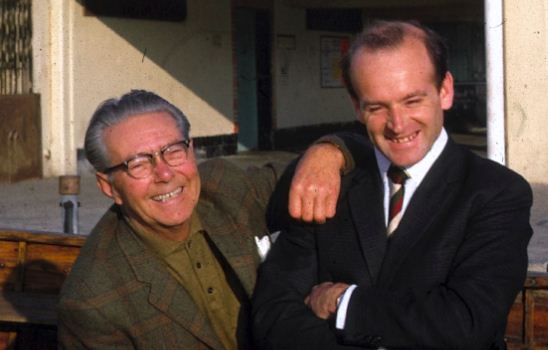
Ronnie
Munro (left) with his
drummer Peter Ward on the
seafront at Brighton 1969
Listen
to 'Music While You Work'
played by Ronnie Munro
and his Sextet
as broadcast around
1963/1964
MUSIC
WHILE YOU WORK
played by Ronnie Munro
and his Sextet
circa 1963/1964
Calling
All Workers (sig)
Limehouse Blues
Shy Serenade
Street of Linden Trees
Maigret Theme
Bracken Brew
Cherokee
Boom
Ladies of Calcutta
Taverna
Flywheel
Lonesome Ranger
Trudie
In a Persian Market
???
Scenic Railway
Calling All Workers(sig)
|
Eric
Coates
Philip Braham
George Scott-Wood
Harold Geller
Ron Grainer
Martin
Ray Noble
Charles Trenet
Gaze
Norrie Paramor
Ronnie Munro
Cecil Norman
Joe Henderson
Albert Ketelbey
???
Roger Roger
Eric Coates |
Listen
to 'Music While You Work'
played by Ronnie Munro
and his Sextet
as broadcast on the BBC
Light Programme at 3.31pm
on 13th May 1966
MUSIC
WHILE YOU WORK
played by Ronnie Munro
and his Sextet
on 13th May 1966
Calling
All Workers (sig)
Betty Dear
A Walk in the Black
Forest
Medley:
. Jeepers
Creepers
. I’m Young and
Healthy
. Lullaby of Broadway
Swinging Baroque
Second Hand Rose
Medley:
. Where is your
heart
. Sous les toits de Paris
. Pigalle
Bond Street Rag
Medley:
. Positano
. Pepito
. Mexican Serenade
Medley:
. Darktown
Strutters Ball
. Je vous aime beaucoup
. Jada
Medley:
. You stepped
out of a dream
. Laura
The Seine
Punch and Judy Polka
Medley:
. How deep is
the Ocean
. Poinciana
. From Russia with love
Russ Conway
Selection:
. Sidesaddle
. China Tea
. Roulette
Arriverderci Roma
Poor People of Paris
Jumping Jiminy
La Vie en rose
Volare
Swedish Rhapsody
Luxembourg Polka
Calling All Workers(sig)
|
Eric
Coates
Raymond Agoult
Horst Jankowski
Norman Warren
Diernhammer
James Hanley
Larue
Rouel Moretti
George Ulmer
Inez Holland
Jack Coles
William Hill-Bowen
Jack Coles
Shelton Brooks
Anna Rossanko
Bob Carleton
Nacio Herb Brown
David Raksin
Guy La Farge
Ronnie Munro
Irving Berlin
Nat Simon
Lionel Bart
Trevor Stanford
Renato Rascel
Margerite Monnot
Moody
Luis Guglielmi
Dom. Modugno
Hugo Alfven
Emile Reisdorff
Eric Coates |
Listen
to 'Music While You Work'
played by Ronnie Munro
and his Sextet
as broadcast on the BBC
Light Programme at
10.31am on 24th January
1966
MUSIC
WHILE YOU WORK
played by Ronnie Munro
and his Sextet
on 24th January 1966
Calling
All Workers (sig)
A Walk in the Black
Forest
Hello Dolly
Jealous Heart
Jeepers Creepers
Young and Healthy
Lullaby of Broadway
I'm in Love with Love
I love Paris
Portugal in Paris
Oh what a Beautiful
Morning
People will Say we're in
Love
Surrey with the Fringe on
Top
Tropical Romance
Betty Dear
It's a Sin to tell a Lie
Winter Wonderland
Snow Bells
Tokio Melody
Ski Waltz
Frasquita Serenade
Trolley Song
Calling All Workers(sig)
|
Eric
Coates
Horst Jankowski
Herman
Carson
Harry Warren
Harry Warren
Harry Warren
Dierhammer
Cole Porter
Ferrao
Richard Rodgers
Richard Rodgers
Richard Rodgers
Ronnie Pleydell
Raymond Agoult
Mayhew
Bernard
Kent
Helmut Zacharias
Ronnie Munro
Franz Lehar
Blayne
Eric Coates |
Listen
to 'Music While You Work'
played by Ronnie Munro
and his Sextet
as broadcast on 21st
October 1963
MUSIC
WHILE YOU WORK
played by Ronnie Munro
and his Sextet
on 21st October 1963
Calling
All Workers (sig)
The Exececutioner's Theme
Selection: The King and I
. March of the
Siamese Children
. I Whistle a Happy Tune
El Adorno
Hors d'Oeuvre
Punch and Judy Polka
Regency Beguine
Medley:
. Side Saddle
. China Tea
. Roulette
Tahitian Twilight
Happy Whistler
The Legion's Last Patrol
Hawaiian War Chant
Paraqueets of Paraguay
Bacciar
Calling All Workers(sig)
|
Eric
Coates
Botkin
Richard Rogers
Leonard
Comer
Ronnie Munro
Ivor Slaney
Russ Conway
Langford
Don Robertson
Lavagnino
Noble
Cedric Dumont
Isobel Brandez
Eric Coates |
Listen
to 'Bright and Early'
played by Ronnie Munro
and his Sextet
as broadcast on 21st July
1964
BRIGHT
AND EARLY
played by Ronnie Munro
and his Sextet
on 21st July 1964
Trolley
Song
Great Day
Brise de Paris
Medley:
. Jeepers
Creepers
. Young and Healthy
. Lullaby of Broadway
Galapagos
Jumping Jiminy
My Ebony Cane
Constantly
Java
Today
Ramona
Bambalina
Never on Sunday
Siboney
Hello Dolly |
Brayne
Vincent Youmans
Albert Delroy
Harry Warren
Ronnie Munro
Galento
Ronnie Munro
Seracini
Toussaint
Sparks
Gilbert
Bernard Ebbinghouse
Hadjidakis
Ernesto Lecuona
Jerry Herman |
Listen
to 'Music While You Work'
played by Ronnie Munro
and his Orchestra
as broadcast on 21st
November 1961
MUSIC
WHILE YOU WORK
played by Ronnie Munro
and his Orchestra
on 21st November 1961
Calling
All Workers (sig)
. (missing segment
approx 14 minutes)
Windows of Paris
Chianti
Medley:
. Smile
. Limelight
Steps of Monaco
Mexican Serenade
La Mer
All over Italy
Climb every mountain
Tango Monaco
There's a tavern in the
town
Medley:
. Serenata
. Sleigh Ride
. Plink, Plank, Plunk
Selection from 'Lilac
Domino'
The London Scottish
Calling All Workers (sig)
|
Eric
Coates
Tony Osborne
Gerhard Winkler
Charles Chaplin
Ivor Slaney/D.Wilson
Jack Coles
Charles Trenet
Ronnie Munro
Richard Rodgers
Lezlo Anales
Trad. arr.Ronnie Munro
Leroy Anderson
Cuvillier and Carr
H.E.Haines
Eric Coates |
(Regretably
about fourteen minutes
are missing from this
recording, but all of the
above are included)
Listen
to 'Music While You Work'
played by Ronnie Munro
and his Sextet
as broadcast on 28th
March 1966
MUSIC
WHILE YOU WORK
played by Ronnie Munro
and his Sextet
on 28th March 1966
Calling
All Workers (sig)
Swing in Baroque
Medley:
. La Ronde
. Under Paris Skies
. Tulips from Amsterdam
Medley:
. Jealous heart
. I left my heart in San
Francisco
Betty Dear
Cobblers' Song
Medley:
. Positano
. Pepita
. Mexican Serenade
Petite Mechante
Selection from 'South
Pacific'
Medley:
. Swedish Rhapsody
. At Last
Medley:
. April in Paris
. La Mer
. I kiss your little
hand, Madame
. Darktown Strutters'
Ball
. Je vous aime beaucoup
. Ja da
Calling All Workers (sig)
|
Eric
Coates
Diernhammer
Oscar Straus
Hubert Giraud
Ralf Arnie
Jennie-Lou Carson
George Cory
Raymond Agoult
Frederic Norton
Jack Coles
William Hill-Bowen
Jack Coles
Ronnie Munro
Richard Rodgers
Charles Wildman
Charles Trenet
Vernon Duke
Charles Trenet
Ralph Erwin
Shelton Brooks
Anna Rosenko
Bob Carleton
Eric Coates |
|